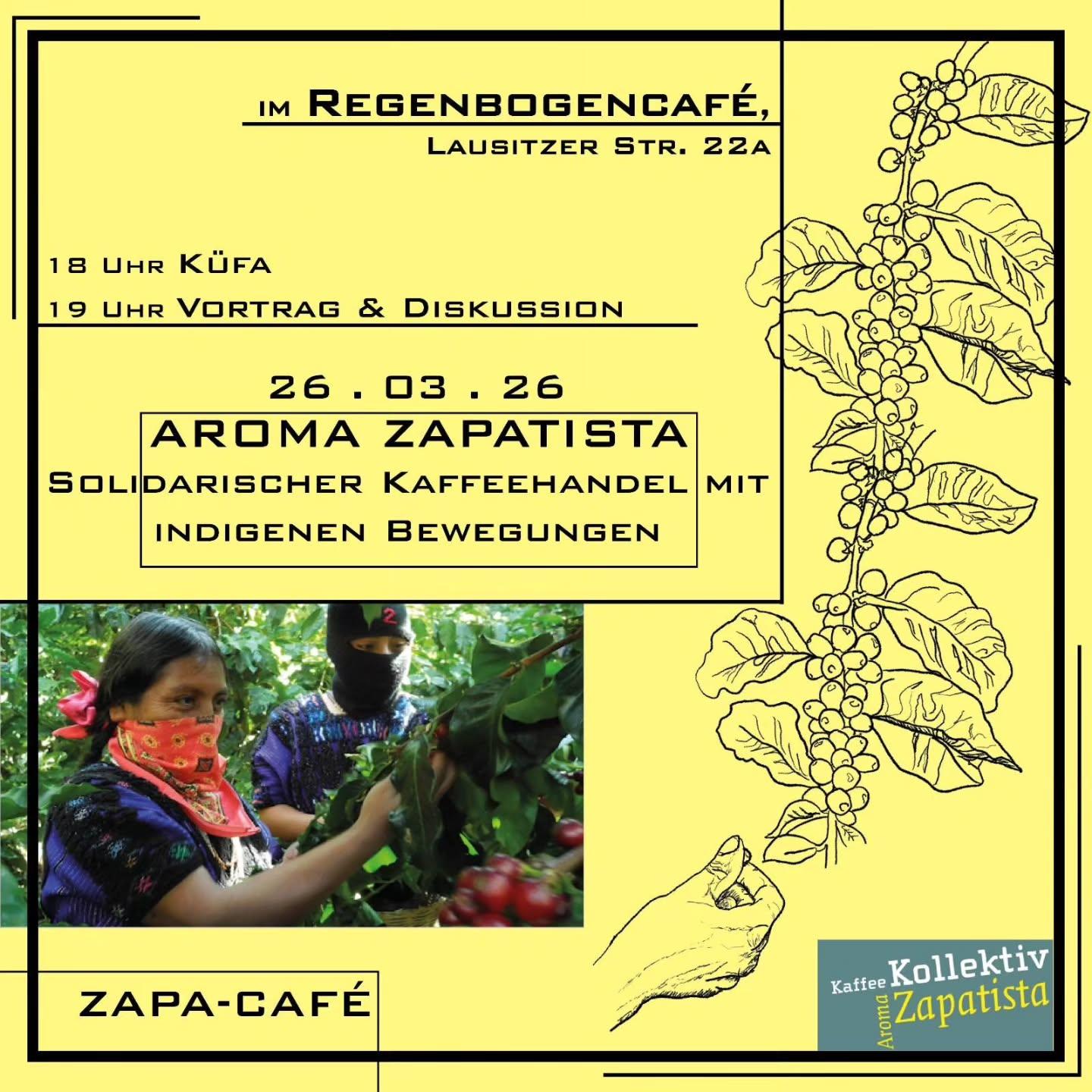
Donnerstag, 26.03.2026 | 18:00 Uhr | 🌈 Regenbogen Cafè ☕️Lausitzer Straße 22a, 10999 Berlin
Anreise: M29 Ohlauer Straße | U1, U3, U8 Kottbusser Tor | U8 Schönleinstraße
📣 Aufruf: https://www.instagram.com/p/DV022LhDKp7/ – @regenbogencafe_xberg
#b2603 #ZapaCafe
Aroma Zapatista im Zapa-Café: Solidarischer Kaffeehandel mit indigenen Bewegungen
🍲 18 Uhr veganes Essen
💬 19 Uhr Vortrag und Diskussion
Das Kollektiv Aroma Zapatista aus Hamburg importiert und verkauft Kaffee von Kleinbäuer*innen aus der zapatistischen Bewegung in Chiapas (Mexiko) und der indigenen Bewegung im Cauca (Kolumbien).
Es versucht mit dem Konzept des solidarischen Handels eine Alternative zur kolonialistischen und kapitalistischen Ausbeutung im Welthandel zu schaffen.
Im Solidarischen Handel werden die Risiken geteilt und Selbstverwaltung der widerständigen Gemeinschaften durch den Verkauf finanziell unterstützt.
Was bedeutet das konkret? Und kann das funktionieren?
Ein Mitglied des Kollektivs stellt den Kontext und die Praxis ihres solidarischen Handels vor und berichtet über ihre Schwierigkeiten und Widersprüche. Anschließend können wir gemeinsam darüber nachdenken.
🫖 A Zapatista atmosphere at Zapa-Café☕️
Thursday, 26.03.2026 | 6.00 pm | 🌈 Regenbogen Café ☕️ Lausitzer Straße 22a, 10999 Berlin
Arrival: M29 Ohlauer Straße | U1, U3, U8 Kottbusser Tor | U8 Schönleinstraße
📣 Call to action: https://www.instagram.com/p/DV022LhDKp7/ – @regenbogencafe_xberg
#b2603 #ZapaCafe
Aroma Zapatista at the Zapa Café: Fair trade coffee in solidarity with indigenous movements
🍲 6.00 pm vegan food
💬 7 pm talk and discussion
The Aroma Zapatista collective from Hamburg imports and sells coffee from small-scale farmers in the Zapatista movement in Chiapas (Mexico) and the indigenous movement in Cauca (Colombia).
Through the concept of fair trade, it seeks to create an alternative to colonialist and capitalist exploitation in global trade.
In fair trade, risks are shared and the self-governance of these communities of resistance is financially supported through sales.
What does this mean in practice? And can it work?
A member of the collective will present the context and practice of their fair trade work and report on the difficulties and contradictions they face. Afterwards, we can reflect on this together.
