
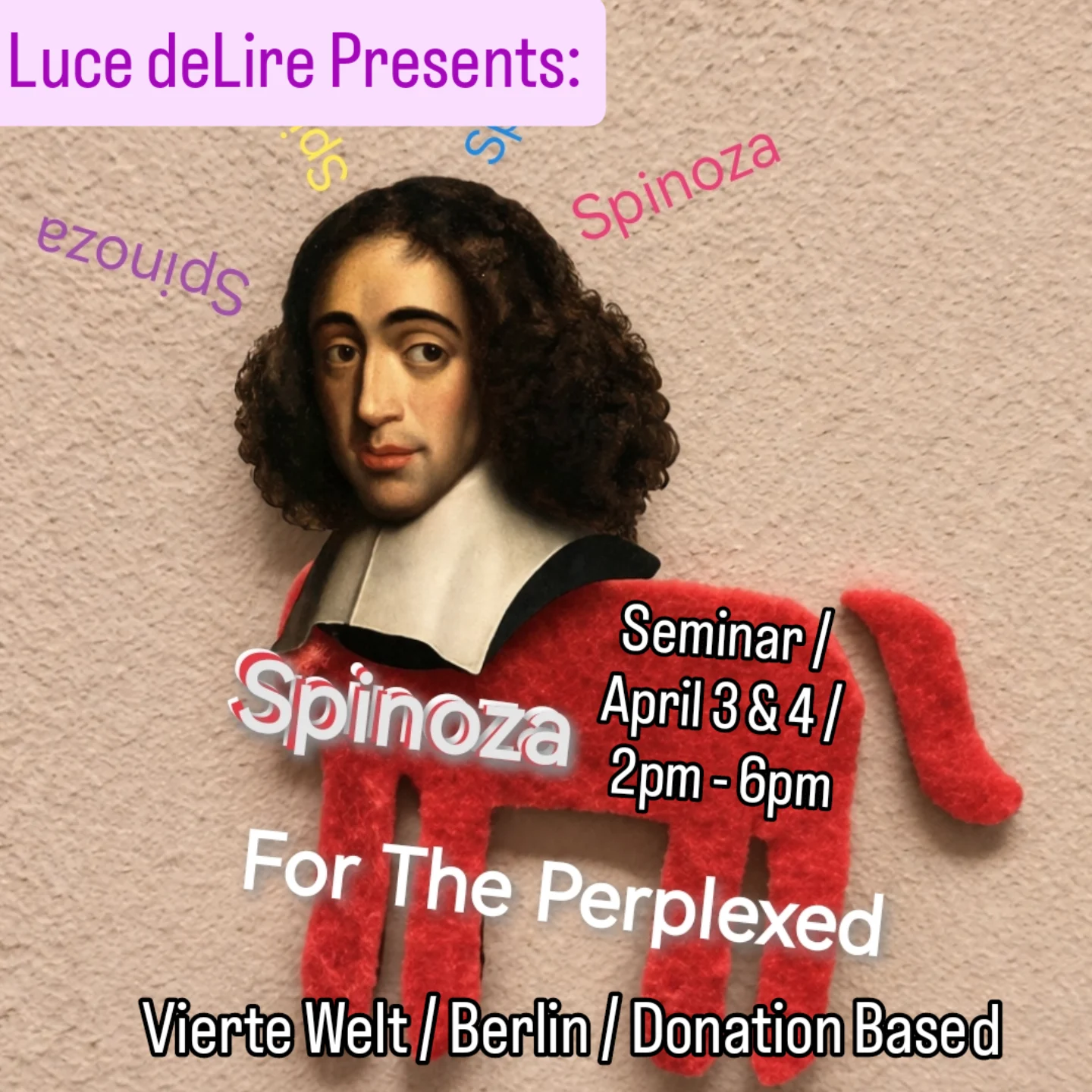
Freitag 03.04.2026 + Samstag 04.04.2026 | 14:00 Uhr bis 18:00 Uhr | Vierte Welt, Kottbusser Tor, Adalbertstraße 96, 10999 Berlin
Anreise: U1, U3, U8, Bus 140 Kottbusser Tor | Bus M29 Adalbertstraße / Oranienstraße
📣 Aufruf: https://www.instagram.com/p/DWIGydKDLyH/ – @luce_delire
#b0304 #b0404
Spinoza für Verwirrte
📅 Wann: 3. und 4. April
⏳ Zeit: 14:00 – 18:00 Uhr
Für Anmeldung, Literatur und weitere Informationen: luce@getaphilosooher.com
Spinoza galt 200 Jahre nach seinem Tod im Jahr 1677 als das „Enfant terrible“ Europas. In den letzten Jahren hat er ein weiteres philosophisches Comeback erlebt.
Warum ist das so? Bei Spinoza trifft strenge Argumentation auf provokante Thesen. Darunter:
Es gibt nur eine einzige Sache auf der Welt, die „Gott“ genannt wird – und dennoch bezeichneten seine Zeitgenossen Spinoza als Atheisten.
Alles geschieht aus absoluter Notwendigkeit. Es gibt keinen freien Willen. Körper und Geist sind ein und dasselbe. Alle politische Theorie und ethische Argumentation sollte durch eine Analyse der Affekte erfolgen und nicht durch eine Bewertung dessen, was richtig und falsch ist.
Politische Macht und politische Legitimität sind ein und dasselbe.
Dennoch soll eine mysteriöse Form der Basisdemokratie die stabilste Regierungsform sein – diese „Demokratie“ müssen wir selbst definieren, da Spinoza starb, bevor er seine politischen Ansichten zu Papier bringen konnte.
Manche nannten sie „Kommunismus“. Leibniz, Wolff, Kant und Hegel betrachteten Spinoza jedoch alle sowohl als Genie als auch als Bedrohung.
Heute bewerten Politikwissenschaftler, Psychologen, Soziologen und Philosophen verschiedener Schulen Spinozas Philosophie im Lichte zeitgenössischer Debatten neu.
Postmarxisten, Poststrukturalisten, Psychologen, affektorientierte Politikwissenschaftler und neue Materialisten knüpfen dort an, wo Spinoza bei seinem Tod aufgehört hat.
Und das werden wir auch tun:
In diesem ersten Crashkurs werden wir uns eingehend mit einigen von Spinozas metaphysischen Thesen befassen und daraus politische Konsequenzen ableiten. Schnallen Sie sich an. Das wird spannend.
📖📜 Luce deLire Presents: Spinoza 📜📖
Friday 03.04.2026 + Saturday 04.04.2026 | 2.00 pm to 6.00 pm | Vierte Welt, Kottbusser Tor, Adalbertstraße 96, 10999 Berlin
Arrival: U1, U3, U8, bus 140 to Kottbusser Tor | Bus M29 to Adalbertstraße / Oranienstraße
📣 Call to action: https://www.instagram.com/p/DWIGydKDLyH/ – @luce_delire
#b0304 #b0404
Spinoza for the Perplexed
📅 When: April 3 & 4
⏳ Time: 2pm – 6pm
For registration, literature and more, contact : luce@getaphilosooher.com
Spinoza was the European enfant terrible for 200 years after his death in 1677. In recen years, he has made yet another philosophical comeback.
Why is that? In Spinoza, argumentative rigor meets hot takes. Among them: there is only one thing in the world, which is called „God“ – and yet, his contemporaries called Spinoza and atheist.
Everything happens with absolute necessity. There is no free will. Body and mind are one and the same thing. All political theory and ethical reasoning should be conducted through an analysis of the affects and not through evaluation of what is right and wrong.
Political power and political legitimacy are one and the same.
Yet a mysterious form of grassroots democracy is supposed to be the most stable form of government – that ‚democracy‘ remains for us to be spelled out because Spinoza died before he could finish writing up his political views.
Some called it ‚communism‘. However, Leibniz, Wolff, Kant and Hegel all judged Spinoza both a genius and a threat.
Today, political theorists, psychologists, sociologists and philosophers of various schools re-evaluate Spinoza’s philosophy in the light of contemporary debates.
Post-marxists, post-structuralists, psychologists, affect oriented political theorists, new materialists are more pick up on where Spinoza left off when he died.
And so will we:
In this first crash course, we will take a deep dive into some of Spinoza’s metaphysical claims and draw some political consequences from them. Fasten your seatbelt. This will be fun.
