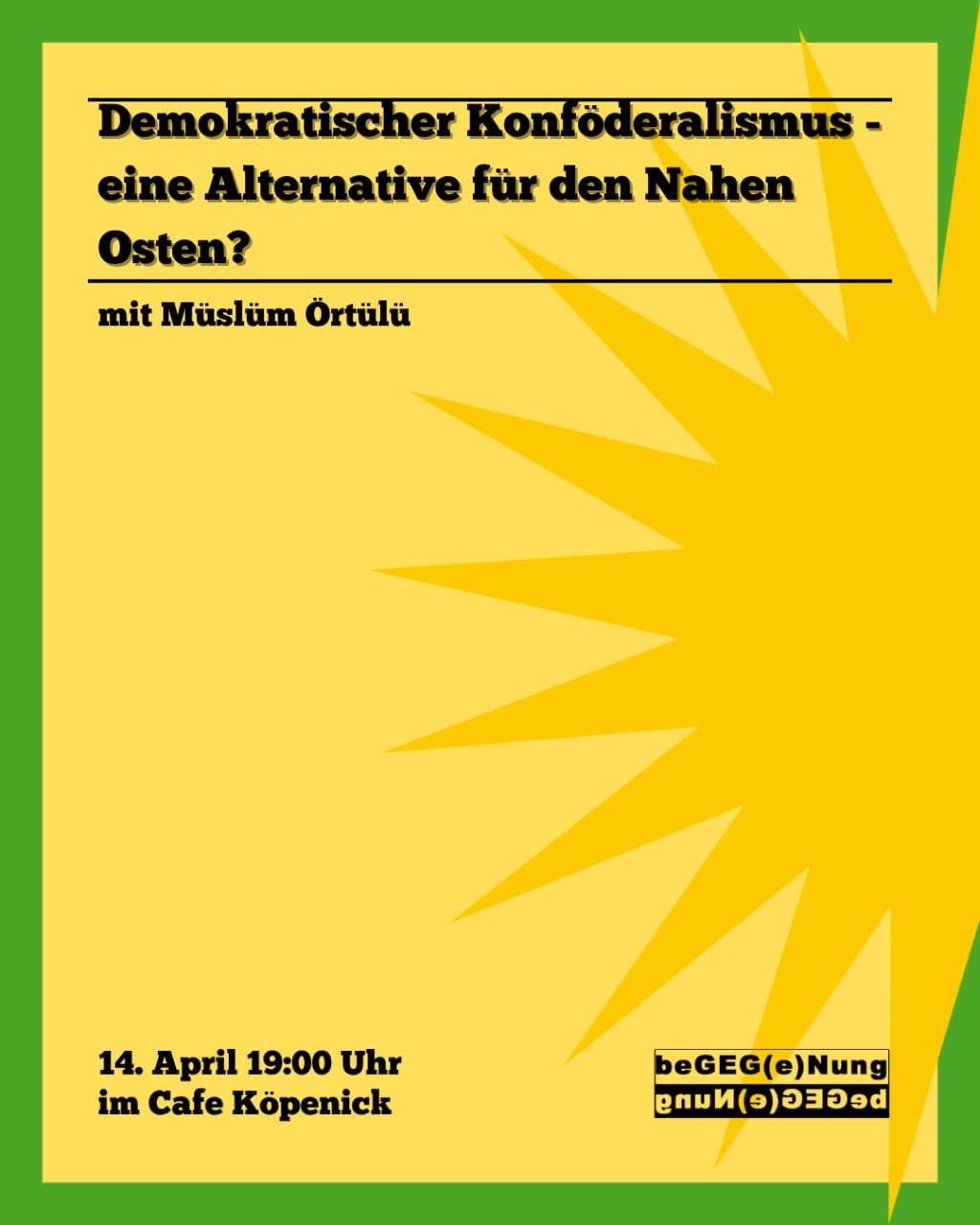
Dienstag 14.04.2026 | 19:00 Uhr | Café Köpenick, Seelenbinderstraße 54, 12555 Berlin
Anreise: Tram 60, 61 Gelnitzstraße | Bus 169 Mandrellaplatz | Tram 27,62, 63, 68 Bahnhofstraße/Seelenbinderstraße | S3, Bus 62, 164, 269, X69, Tram 68 S-BHf Köpenick
📣 Aufruf: https://asanb.noblogs.org/?p=16634
#b1404 #DemokratischerKonföderalismus
Kriege, Vertreibung, politische Krisen: Im Nahen und Mittleren Osten scheint es seit Jahrzehnten kaum Ruhe zu geben.
Viele fragen sich: Gibt es überhaupt einen Weg aus diesem Dauer- Krisenmodus? Und wenn ja – wie könnte ein Gesellschaftsmodell aussehen, das Konflikte nicht immer wieder neu produziert?
Die kurdische Freiheitsbewegung bringt dafür ein Modell ins Gespräch:
Demokratischer Konföderalismus.
Die Idee: Weg von einem Staat, der alles von oben bestimmt – hin zu einer Gesellschaft, die von unten organisiert ist.
Aber: Woher kommt dieses Modell? Welche Theorie steckt dahinter? Und kann das in einer Region funktionieren, die von Krieg und Druck von außen geprägt ist? Ist demokratischer Konföderalismus wirklich eine realistische Alternative – oder eher ein Ideal?
Referent: Müslüm Örtülü
Er forscht zum demokratischen Konföderalismus und zur Praxis in Nord- und Ostsyrien. Gemeinsam mit ihm diskutieren wir, ob dieses Modell Antworten auf die großen Fragen unserer Zeit geben kann.
📜 Democratic confederalism – an alternative for the Middle East? 📜
Tuesday 14.04.2026 | 7.00 pm | Café Köpenick, Seelenbinderstraße 54, 12555 Berlin
Arrival: Tram 60, 61 to Gelnitzstraße | Bus 169 to Mandrellaplatz | Tram 27, 62, 63, 68 to Bahnhofstraße/Seelenbinderstraße | S3, Bus 62, 164, 269, X69, Tram 68 to Köpenick S-Bahn station
📣 Call to action: https://asanb.noblogs.org/?p=16634
#b1404 #DemocraticConfederalism
Wars, displacement, political crises: for decades, there has been little respite in the Middle East.
Many are asking: is there any way out of this perpetual state of crisis? And if so, what might a social model look like that does not constantly reproduce conflict?
The Kurdish freedom movement is putting forward a model for this:
Democratic confederalism.
The idea: moving away from a state that dictates everything from above – towards a society organised from below.
But: where does this model come from? What theory lies behind it? And can it work in a region marked by war and external pressure? Is democratic confederalism really a realistic alternative – or more of an ideal?
Speaker: Müslüm Örtülü
He researches democratic confederalism and its implementation in Northern and Eastern Syria. Together with him, we will discuss whether this model can provide answers to the big questions of our time.
