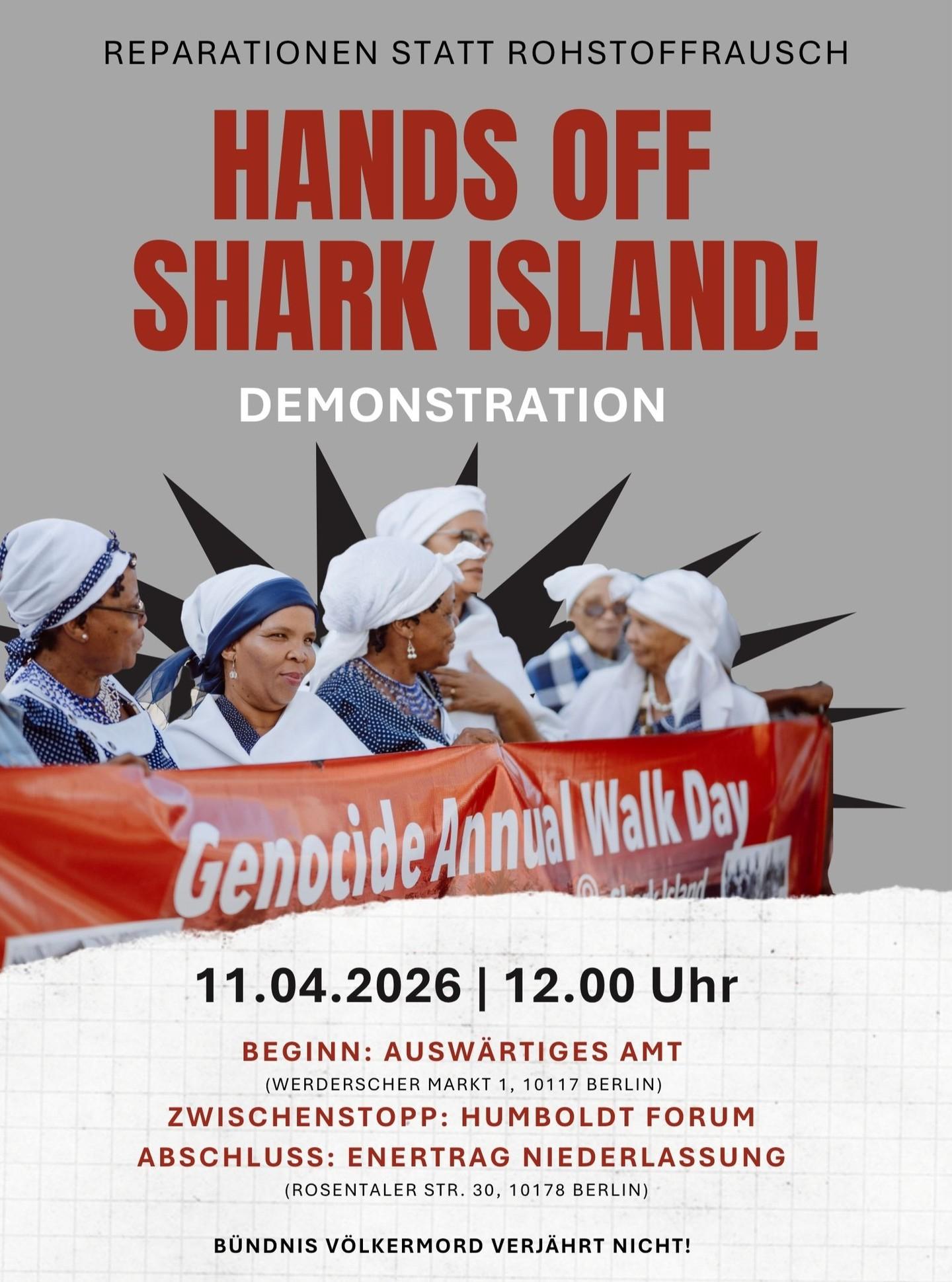
Samstag, 11.04.2026 | 12:00 Uhr | Werderscher Markt 1, 10117 Berlin
Anreise: U5, Bus 100, 300 Museumsinsel | Bus 147 Werderscher Markt | U2 Hausvogteiplatz
📣Aufruf: https://www.instagram.com/p/DW6BQD2iHWU/ – @decolonizebln
#b1104 #HandsOffSharkIsland!
🗺️ Voraussichtliche Route:
- Werderscher Markt (AP)
- Schinkeplatz
- Haupteingang Humboldforum (ZK)
- Am Lustgarten
- Bodestraße
- Friedrichsbrücke
- Burgstraße
- Henriette-Herz-Platz
- An der Spandauer Brücke
- Rosenthaler Straße
- Rosenthaler Straße/Gipsstraße (EP)
Gedenken – Protest – Solidarität mit den Nachfahren des Völkermordes
Hände weg von Shark Island – Reparationen statt Rohstoff-Rausch
Während die betroffenen Gemeinschaften in Namibia protestieren und eine Menschenkette zum Schutz von Shark Island bilden, zeigen wir zeitgleich am 11. April um 12:00 Uhr in Berlin unsere Solidarität.
Kommt zur Demonstration und kämpft mit uns für: Anerkennung. Wiedergutmachung. Hände weg von Shark Island
Start: Auswärtiges Amt (Werderscher Markt 1, 10117 Berlin
Zwischenstopp: Humboldt Forum
Abschluss: Firmengebäude von Enertrag (Rosentaler Str. 30)
Hintergrund: Das Deutsche Kaiserreich verübte zwischen 1904 und 1908 einen Genozid an den Ovaherero und Nama sowie Damara und San im heutigen Namibia.
Bis heute weigert sich die Bundesregierung, diesen Genozid juristisch anzuerkennen.
Statt echter Aufarbeitung verhandelt Deutschland ein Abkommen mit Namibia – ohne die legitimen Vertreter:innen der betroffenen Gemeinschaften.
Dieses Abkommen vermeidet Reparationen und dient vor allem deutschen Interessen.
Gleichzeitig treiben deutsche Unternehmen wie Enertrag mit politischer Unterstützung der Bundesregierung ein Mega-Projekt zur Erzeugung von „grünem“ Wasserstoff voran.
Das Problem? Es ist auf Land geplant, das den Nama im Zuge des Genozids geraubt wurde. Zudem soll der Hafen von Lüderitz ausgebaut werden, um Exporte in den Globalen Norden zu ermöglichen.
Dieses Projekt bedroht Shark Island.
Auf dieser Halbinsel befand sich ein Konzentrationslager, in dem Schätzungen zufolge rund 4.000 Ovaherero und Nama ums Leben kamen.
Shark Island ist deshalb für die Nachfahren der Überlebenden ein zentraler Ort des Gedenkens, der Trauer und des Widerstands.
Ein Ort, der nicht wirtschaftlichen Interessen geopfert werden darf.
🔥✊🏾Hands off Shark Island!✊🏾🔥
Saturday, 11.04.2026 | 12:00 | Werderscher Markt 1, 10117 Berlin
Arrival: U5, bus 100, 300 (Museumsinsel) | bus 147 (Werderscher Markt) | U2 (Hausvogteiplatz)
📣Call to action: https://www.instagram.com/p/DW6BQD2iHWU/ – @decolonizebln
#b1104 #HandsOffSharkIsland!
🗺️ Expected route:
- Werderscher Markt (AP)
- Schinkeplatz
- Main entrance to Humboldt Forum (ZK)
- Am Lustgarten
- Bodestraße
- Friedrichsbrücke
- Burgstraße
- Henriette-Herz-Platz
- An der Spandauer Brücke
- Rosenthaler Straße
- Rosenthaler Straße/Gipsstraße (EP)
Remembrance – Protest – Solidarity with the descendants of the genocide
Hands off Shark Island – Reparations instead of a resource frenzy
Whilst the affected communities in Namibia are protesting and forming a human chain to protect Shark Island, we will be showing our solidarity at the same time on 11 April at 12:00 in Berlin.
Come to the demonstration and fight with us for: Recognition. Reparations. Hands off Shark Island
Start: Federal Foreign Office (Werderscher Markt 1, 10117 Berlin)
Stop-off: Humboldt Forum
End: Enertrag company building (Rosentaler Str. 30)
Background: Between 1904 and 1908, the German Empire committed genocide against the Ovaherero, Nama, Damara and San peoples in what is now Namibia.
To this day, the German government refuses to legally recognise this genocide.
Instead of genuine reconciliation, Germany is negotiating an agreement with Namibia – without the legitimate representatives of the affected communities.
This agreement avoids reparations and primarily serves German interests.
At the same time, German companies such as Enertrag are pushing ahead with a mega-project to produce ‘green’ hydrogen, with political support from the German government.
The problem? It is planned on land that was stolen from the Nama during the genocide. Furthermore, the port of Lüderitz is to be expanded to facilitate exports to the Global North.
This project threatens Shark Island.
This peninsula was the site of a concentration camp where, according to estimates, around 4,000 Ovaherero and Nama lost their lives.
Shark Island is therefore a central place of remembrance, mourning and resistance for the descendants of the survivors.
A place that must not be sacrificed to economic interests.
